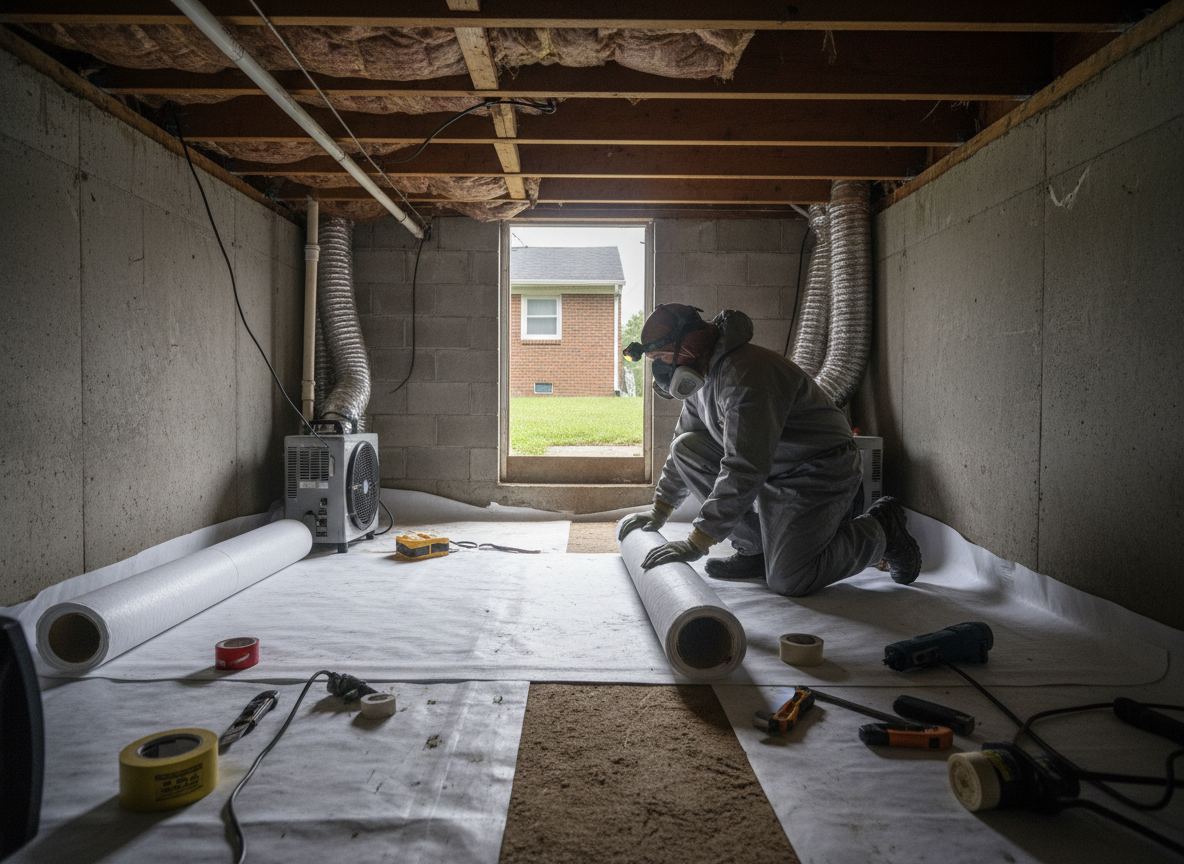
Crawl space homes are common across York, especially in older neighborhoods like North York and West York where houses were built with rubble stone or block foundations sitting a few feet off native soil. These crawl spaces almost never seal well on their own — dirt floors, fieldstone walls with gaps, and old vent openings all give radon a direct path from the soil into the living space above. Unlike a slab job, you can't just drill a suction pit through concrete; you're building a sealed membrane system over open ground, which means the ground itself matters more than anything.
York County sits on a mix of limestone, shale, and diabase geology, and the soil under crawl spaces varies block by block — sometimes literally house to house on the same street in Devers or Pinehurst. Where soil is tighter clay, sub-membrane suction has to pull harder and often needs a mechanically sealed liner rather than a lightweight barrier to hold vacuum. Where soil is looser and more permeable, we can sometimes get by with a single suction point instead of two. Guessing wrong on this is the number one reason a crawl space system underperforms after installation.
Moisture is the other half of the job. York's humid continental climate means crawl spaces run damp much of the year and can flood or seep after heavy spring rain or winter thaw, especially in lower-lying spots near Codorus Creek tributaries. A radon vapor barrier isn't just a radon tool here — it doubles as ground moisture control, so we grade drainage, deal with standing water or a sump pit before sealing, and use a barrier rated for constant ground contact, not a thin painter's plastic that tears the first time someone crawls under the house for plumbing work.
One code-adjacent note: sealed crawl spaces change how a house breathes. If there are gas appliances, an old oil tank, or a water heater down there, we have to confirm combustion air isn't being starved once the space is sealed and depressurized — that's a life-safety issue, not just a radon number issue, and it's a step some fly-by-night installs skip.
Technician insight
In York, the thing that catches most people out with crawl space mitigation is assuming one suction point works everywhere — it doesn't, because the soil under a house in Spring Garden Township can be totally different from one two streets over near Pinehurst. I've had to add a second suction point on jobs where the homeowner had already paid someone else for a single-point system that never brought numbers down. The other mistake is sealing the crawl space tight without checking whether a gas water heater down there still gets enough combustion air.
Older Farmhouse Crawl Space Near East York
A homeowner near East York had a fieldstone-foundation crawl space with a dirt floor and standing water after spring rain. Testing showed elevated radon and the moisture was making the space nearly impossible to access safely. We installed a sealed vapor barrier tied into a new sump lid, ran dual suction points because of the tight clay soil, and vented the fan through the rim joist above roofline. A retest a few weeks later showed levels well below where they started, and the crawl space stayed dry through the next round of heavy rain.
Crawl Space Mitigation Services We Offer
✓Crawl Space Vapor Barrier Sealing
Heavy-duty ground barrier sealed to piers, walls, and penetrations to cut off the soil gas path — standard on nearly every crawl space job we run in York County.
✓Sub-Membrane Suction Systems
A fan-driven suction point (or two, depending on soil type) pulls radon from beneath the sealed membrane and vents it above the roofline, the same approach used in stubborn homes around North York.
✓Sump Pit Radon Sealing
Airtight sump lids with gasketed access, common where crawl spaces near Codorus State Park's watershed drain into a pit that would otherwise act as a wide-open radon inlet.
✓Crawl Space Fan Installation & Relocation
Sizing and mounting the mitigation fan outside the conditioned envelope — usually in the crawl space rim, garage, or exterior wall — to keep noise and moisture out of living areas.
✓Combustion Air Safety Checks
Verification that sealing the crawl space hasn't starved a gas water heater, furnace, or other combustion appliance of make-up air, required on any older home with equipment down there.
✓Crawl Space Radon Testing & Diagnostics
Pre- and post-mitigation testing to confirm the system is actually pulling levels down, not just installed — useful for real estate transactions common around Downtown York and West York.
Crawl Space Mitigation Cost in York, PA
| Service | Typical Range | What Affects It |
|---|---|---|
| Radon Test (Short-Term) | $100–$175 | Often credited toward mitigation if you move forward |
| Vapor Barrier + Sub-Membrane Suction (single point) | $1,200–$1,800 | Depends on crawl space size and accessibility |
| Vapor Barrier + Dual Suction Points | $1,800–$2,600 | Needed for tighter clay soils or larger crawl spaces |
| Sump Pit Sealing (add-on) | $150–$350 | Varies with pit condition and lid type needed |
| Combustion Air Safety Modification | $100–$400 | Only needed if gas appliances are present in the sealed space |
| Post-Install Retest | $100–$175 | Confirms system is pulling levels down as designed |
Ranges are typical for York, PA and confirmed with an exact written quote before any work starts.
How it works
- 1
Crawl Space Inspection & Soil Assessment
We get under the house, check soil type, moisture, foundation gaps, and any existing vapor barrier or sump, and note appliance locations before quoting a system.
- 2
Test or Confirm Radon Levels
If you haven't already got a reading, we place a short-term test to confirm current radon levels before committing to a system design.
- 3
Membrane & Sealing Work
We lay and seal a continuous vapor barrier over the crawl space floor, sealing it to piers, foundation walls, and any sump lid or plumbing penetrations.
- 4
Suction Point & Fan Install
One or two suction points are set based on soil permeability, connected to an exterior-mounted fan that vents above the roofline.
- 5
Post-Install Verification
A follow-up test confirms the system has brought radon levels down before we call the job finished.
Pricing
Crawl space systems typically run a bit higher than a comparable slab-only system because of the vapor barrier material and extra sealing labor — most York County crawl space jobs land in the mid-range once soil and moisture conditions are accounted for.