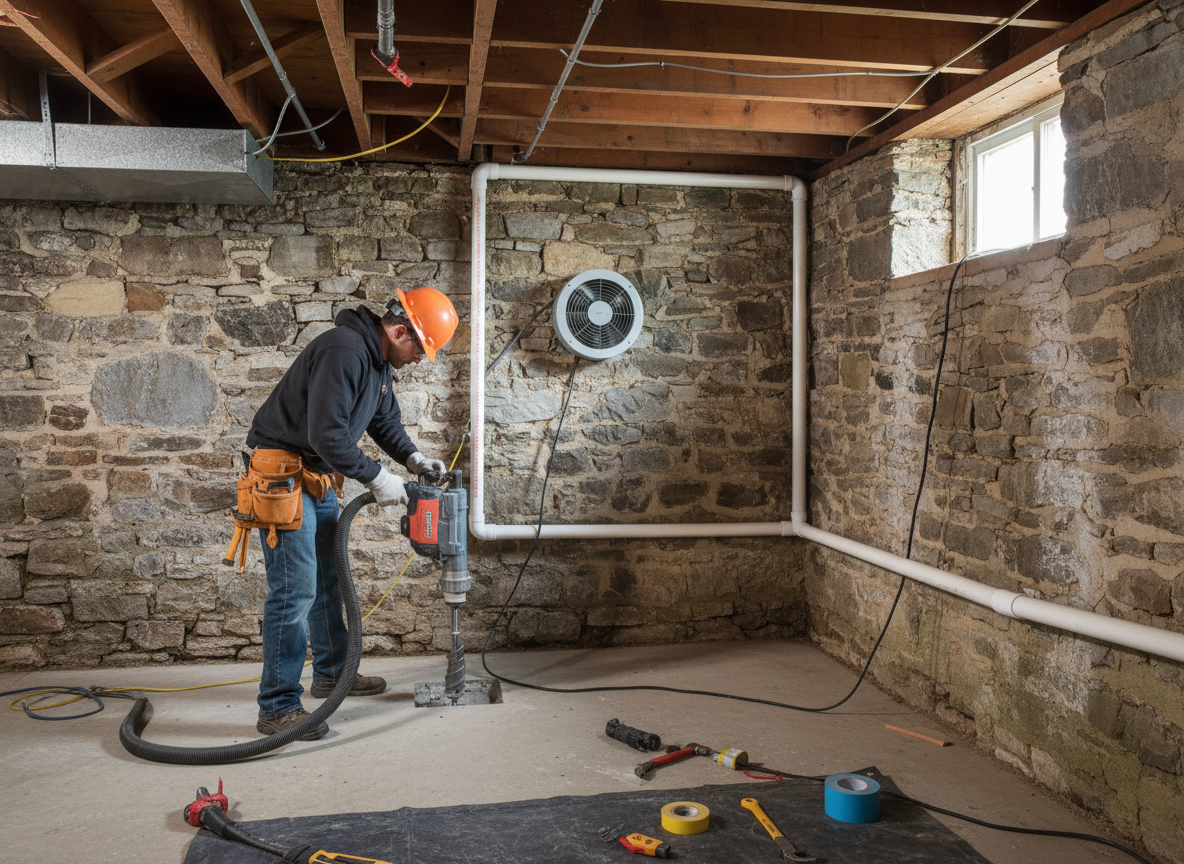
Sub slab depressurization (SSD) works by creating negative pressure beneath the concrete slab so soil gas is drawn into a pipe network and vented above the roofline instead of seeping up through slab cracks, sump pits, and utility penetrations. Most homes in York County — whether it's a brick rowhome in Downtown York, a mid-century rancher in West York, or a newer build out toward Spring Garden Township — sit on slabs poured over varying depths of fill material, and that fill matters. Where the aggregate under the slab is coarse and well-connected, one suction point can depressurize the whole footprint. Where it's compacted clay or fine soil, common in parts of North York and East York, we often need two or more suction points to get even vacuum readings across the slab.
York's older housing stock adds wrinkles. Homes built before slab insulation and vapor barrier requirements were standard often have unsealed expansion joints, hairline cracks radiating from the slab edge, and sometimes multiple pours from additions over the decades — each seam is a potential entry point that needs sealing for the system to perform as designed. In basements near Codorus State Park and the more sloped lots toward the western edge of the county, we also see block foundation walls with hollow cores that need their own suction or sealing strategy, since SSD alone won't address soil gas entering through open block.
Winters here get cold enough that fan placement and pipe routing through unheated attics or garages need attention — PVC joints and fan housings can be affected by extreme temperature swings between our humid summers and freezing winters, so we route exhaust piping to minimize exposure and use solvent-welded joints rated for the swing. Code-wise, radon vent stacks need to terminate above the roofline and away from windows or eaves per general radon mitigation standards, which is straightforward on most York rowhomes but takes planning on multi-story homes near Devers and Pinehurst where roof pitch and dormers limit routing options.
A common edge case: homes with finished basements. Running exposed PVC through a finished space isn't acceptable to most homeowners, so we route through closets, behind soffits, or exterior-mounted with the fan outside — each option changes labor and materials cost.
Technician insight
In York, the thing that catches most people out with SSD is assuming one suction point works everywhere — it doesn't, especially in West York and North York homes on compacted clay fill where a single point leaves half the slab undepressurized. I've also seen homeowners try to skip sealing the sump pit lid because it 'still needs to drain water' — you can seal it airtight and still let water through with the right fitting, but a loose lid will quietly kill your system's vacuum.
Rowhome Near Central Market House With Uneven Vacuum Readings
A homeowner near Central Market House had a system installed by another contractor that tested fine at the fan but still showed elevated radon readings in one bedroom corner. We found the sub-slab fill under that section was denser clay, isolating it from the single suction point. Adding a second suction pipe near that corner and re-sealing an unnoticed expansion joint brought vacuum readings even across the whole slab.
Sub Slab Depressurization Services We Offer
✓Single-Point SSD Installation
One suction point and fan system for slabs with well-connected sub-slab material — the most common setup for standard York County ranch and colonial homes.
✓Multi-Point SSD Systems
Additional suction pipes for slabs with compacted or layered fill, common in parts of North York and East York where a single point won't pull consistent vacuum.
✓Sump Pit Integration
Sealing and converting an existing sump pit into the primary suction point, common in homes near Codorus State Park with active water management systems.
✓Exterior Fan Mounting
Routing the vent pipe and mounting the fan outside the home for finished basements or homes where interior routing isn't practical.
✓Block Wall Suction Points
Additional suction addressing hollow-core block foundation walls that SSD alone won't depressurize, common in older Downtown York and West York homes.
✓Multi-Family and Rowhome Systems
Adapted SSD layouts for shared-wall rowhomes typical of Downtown York, where slab access and shared foundations require careful diagnostic testing before installation.
✓Post-Installation Diagnostic Testing
Smoke testing and manometer readings across the slab to confirm suction reaches every section before we close out the job.
✓System Retrofits and Repairs
Fixing underperforming or improperly sealed SSD systems installed by others, including re-sealing penetrations and re-routing undersized piping.
Sub Slab Depressurization Cost in York, PA
| Service | Typical Range | What Affects It |
|---|---|---|
| Single-point SSD system | $900–$1,500 | Standard slab, one suction point, interior fan routing |
| Multi-point SSD system | $1,400–$2,200 | Two or more suction points for compacted or layered sub-slab fill |
| Sump pit conversion | $800–$1,300 | Uses existing sump pit as suction point, reduces coring labor |
| Exterior fan mounting upgrade | $150–$350 | Added cost for finished basements needing outside-mounted fans |
| Block wall suction addition | $300–$700 | Extra suction point for hollow-core block foundations |
| System retrofit/repair | $200–$600 | Depends on whether re-sealing or full re-routing is needed |
Ranges are typical for York, PA and confirmed with an exact written quote before any work starts.
How it works
- 1
Diagnostic Slab and Soil Assessment
We check sub-slab material, existing cracks, sump pits, and foundation type to determine how many suction points the home needs before quoting.
- 2
Suction Point Placement
We core the slab or use an existing sump pit, install the pipe fitting, and seal it airtight — the seal quality here determines long-term performance.
- 3
Pipe Routing and Fan Installation
PVC pipe runs through the basement, garage, or exterior wall to the fan, positioned to route exhaust above the roofline away from windows and eaves.
- 4
Sealing Slab Penetrations
Expansion joints, floor drains, and visible cracks get sealed with radon-rated caulk so the system pulls vacuum evenly rather than short-circuiting through gaps.
- 5
Pressure and Performance Testing
Manometer readings confirm negative pressure across the full slab; we adjust or add suction points if any section reads flat.
Pricing
Most single-family SSD installs in York County run mid-range for radon mitigation work; homes needing multiple suction points, block wall sealing, or exterior fan routing cost more due to added labor and materials.