2026-08-20 · Dave Kessler · 4 min read
Mold Behind Drywall in Finished Basements
A finished basement is a nice room until the back of the drywall has been wet for a summer.
- Why finished basements in York fail this way
- Clues short of demolition
- Opening a wall without making a bigger mess
- What “mold-resistant” board does not do
Why finished basements in York fail this way
A lot of 1970s–2000s finishes in East York, North York, and Spring Garden are studs, fiberglass, and paper-faced drywall held right against block or stone. The foundation is cooler than the room. Summer air leaks in, condenses, and the only thing that cannot dry is the back of the paper. You smell it in the family room and see nothing on the paint.
Rowhome cellars downtown are less often “finished” and more often parged stone with a storage corner. The failure there is boxes and a sofa on a floor that wicks. Different detail, same rule: organic material plus hidden damp.
Clues short of demolition
- Musty smell that improves when the dehumidifier has run for two days and returns when it has not.
- Paint blisters or tide lines in the bottom 12–18 inches.
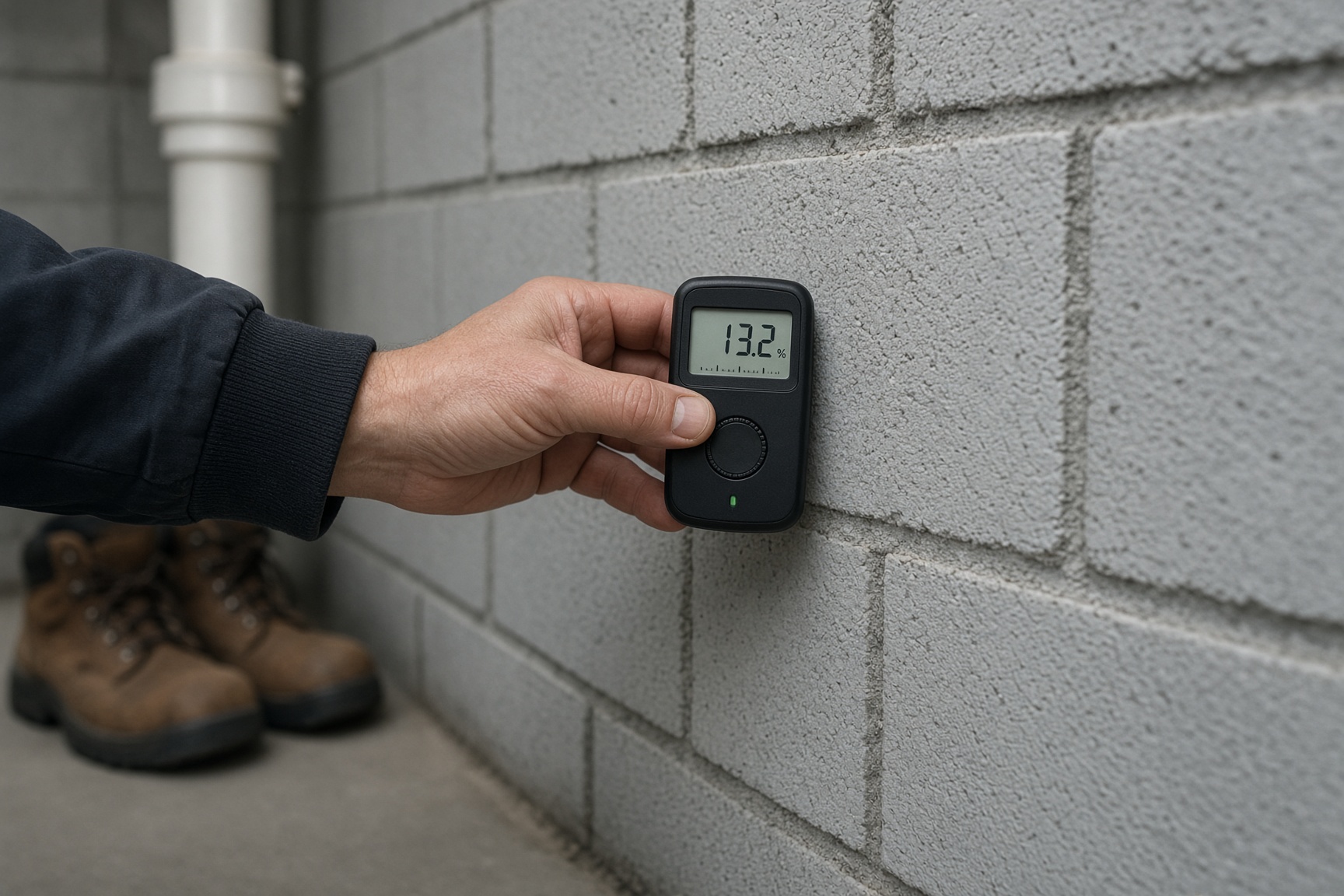
- Pinless meter readings that stay high on the drywall but the concrete floor looks dry.
- Efflorescence or dark block visible in an unfinished mechanical corner of the same foundation.
- A history of water at that wall during hard rain, even if it is “only a little.”
An air sample will not map which bay is wet. A meter and a small inspection cut will. Read can mold grow behind drywall if you want the short version before you open anything.
Opening a wall without making a bigger mess
If you cut, cut enough to see the back of the sheet and the insulation, and bag debris as you go. Fiberglass that has been wet belongs in the trash, not “fluffed and reused.” Do not run the HVAC while you are pulling paper-faced board. A window and a dehumidifier in that room are enough air for a small opening. Stop if you find more than you planned — that is information, not a dare.
Leave the masonry exposed until it is dry and you understand the water. Covering it the same Saturday with new drywall and a “mold resistant” label repeats the experiment. Cement board or a removable inspection panel beats a forever wall on a foundation that still weeps.
What “mold-resistant” board does not do
Fiberglass-faced or paperless board resists mold better than paper-faced gypsum. It does not stop liquid water, and it does not forgive a wall with no drainage. If the outside grade, gutters, and footer drain are wrong, the inside product is a costume. Fix the outside water when you can get to it: downspouts, soil slope away from the house, and window wells that drain.
Questions people also ask
+Should I seal basement walls with waterproof paint to stop mold?
+Is a musty finished basement safe to sleep in?
These pages are homeowner education from Radon Mitigation of York, written by Dave Kessler. They are not a medical diagnosis, a species identification, or an insurance determination. Color does not tell you which mold you have. If someone in the house is sick, talk to a physician. EPA's homeowner guidance treats roughly 10 square feet as the line where many people stop DIY cleanup and call a remediation crew — sooner if sewage, HVAC, or anyone immunocompromised is involved. We are a radon and basement crew. When we are already under a York house we will tell you what we see and what we would do in our own place. We do not pretend a radon fan is a mold remedy.