2026-09-16 · Dave Kessler
Local Geology and Radon Risk in York County
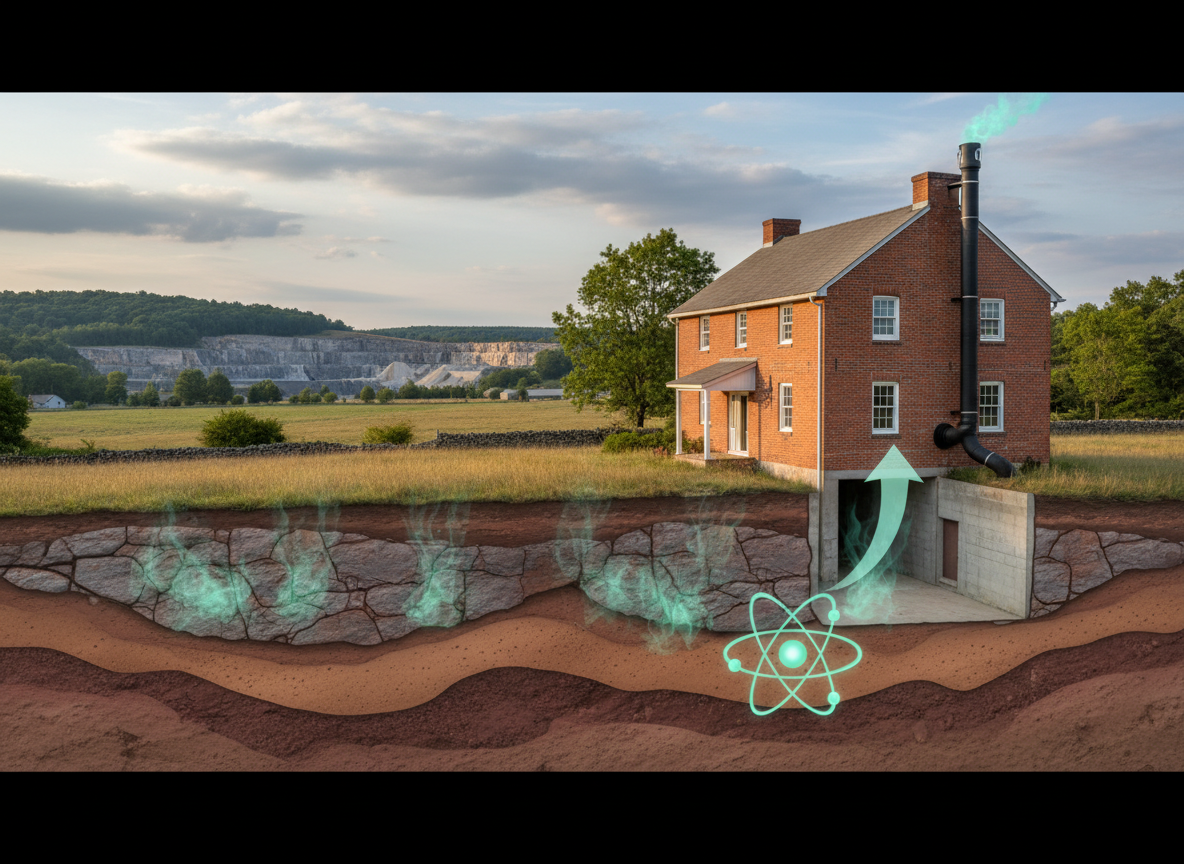
York County's radon risk is driven almost entirely by what's under your foundation, not by which neighborhood you live in — homes sitting over the county's limestone and carbonate bedrock, common through Spring Garden Township and parts of Downtown York, tend to run higher due to fractured, porous rock that lets soil gas move freely, while homes on denser diabase or shale closer to East York and North York can still test high because of tight cracks that concentrate gas flow under the slab. I've pulled readings above 10 pCi/L on both rock types in the same week, which tells you geology sets the odds but doesn't guarantee the outcome — testing is still the only way to know.
Why York County's Bedrock Matters
York County sits on a mix of Cambrian-Ordovician limestone, dolomite, and metamorphosed diabase intrusions left over from ancient volcanic activity. Limestone and dolomite are prone to solution channels and fractures that act like plumbing for radon gas moving up from decaying uranium deep in the bedrock. I see this constantly in the flatter ground around Central Market House and toward the Spring Garden Township line, where basements dug into carbonate rock show consistently elevated readings. Diabase, by contrast, is denser but still fractures along joints, and those fracture zones can funnel gas into a concentrated point rather than spreading it out — meaning a house 50 feet away might test completely different. This is exactly why a single neighborhood-wide assumption never holds up here; every lot's rock contact and soil depth changes the picture.
Soil Type and Moisture Add Another Layer
Beyond bedrock, the soil sitting on top of it matters just as much. Much of York County has thin, well-drained silty soils over rock, especially in the rolling terrain near Codorus State Park, and thin soil means less natural filtering of soil gas before it reaches a foundation. Clay-heavy soils found in pockets of West York slow gas migration somewhat but also trap moisture, which can push radon through cracks during wet spring thaws. Our humid continental climate compounds this: hot, humid summers cause homes to run air conditioning with windows shut, and cold winters mean furnaces run constantly and stack-effect draws basement air upward — both conditions lower the natural air exchange rate and let radon concentrate indoors. If you want to understand how winter specifically changes readings, we cover that in detail in why winter increases radon readings in Pennsylvania.
Housing Age and Foundation Type Change the Fix
Geology explains where radon comes from, but the age and construction of the house determines how it gets in and how hard it is to stop. Downtown York and older sections of East York have a lot of stone and rubble foundations from the early 1900s, and those foundations have irregular gaps, dirt floors in some cases, and no consistent slab to seal against. Newer construction out toward North York and Devers typically has a poured concrete slab, which is actually easier to mitigate because a single sub-slab depressurization point can often pull air from the entire footprint. Homes with crawl spaces, common in some of the older Pinehurst-area properties, need a different approach entirely since there's no slab to draw from — that's covered under crawl space mitigation rather than a standard sub-slab system.
What This Means for Testing and System Design
Because bedrock and soil vary so much lot to lot in York County, I never quote a mitigation system off geology alone — every job starts with an actual test. Short-term test kits over 2-4 days give a baseline, but I recommend homeowners near known high-carbonate zones, including much of Spring Garden Township and Downtown York, do a longer test or retest seasonally since readings swing with soil moisture and heating patterns. If you haven't had a baseline done, radon testing is the starting point before anyone should be talking about installing pipe and fans. For houses already showing elevated numbers, sub slab depressurization is the standard fix on slab foundations, pulling gas from beneath the concrete before it ever enters the living space.
A Note on Older York Properties
Older homes near the York County Courthouse and around the Strand-Capitol Performing Arts Center often have multiple foundation pours, sump pits, and old utility penetrations that each act as an entry point regardless of what the bedrock is doing. I've walked basements where three different additions over 80 years created three different slab elevations, and each seam needed its own sealing and suction consideration. If you're curious about the specific weak points common in these older builds, we go through them in common radon entry points in older York properties. These homes usually cost more to mitigate properly not because the geology is worse, but because the foundation itself is more complicated to seal and depressurize evenly.