2026-08-06 · Dave Kessler · 4 min read
How to Tell If You Have a Mold Problem
You usually do not need a lab to decide that a basement is too damp to ignore. You need a flashlight and an honest nose.
- The checks that actually work
- Room by room in a typical York house
- When a test is worth paying for
- What a false alarm looks like
The checks that actually work
- Smell. A cellar that smells like wet cardboard or a closet that hits you when the door opens is telling the truth, even if you cannot find the colony yet.
- Sight. Speckles, smears that look like soot, fuzzy patches on joists, black dots on window gaskets, or pinkish film on shower caulk. Color alone does not name the species.
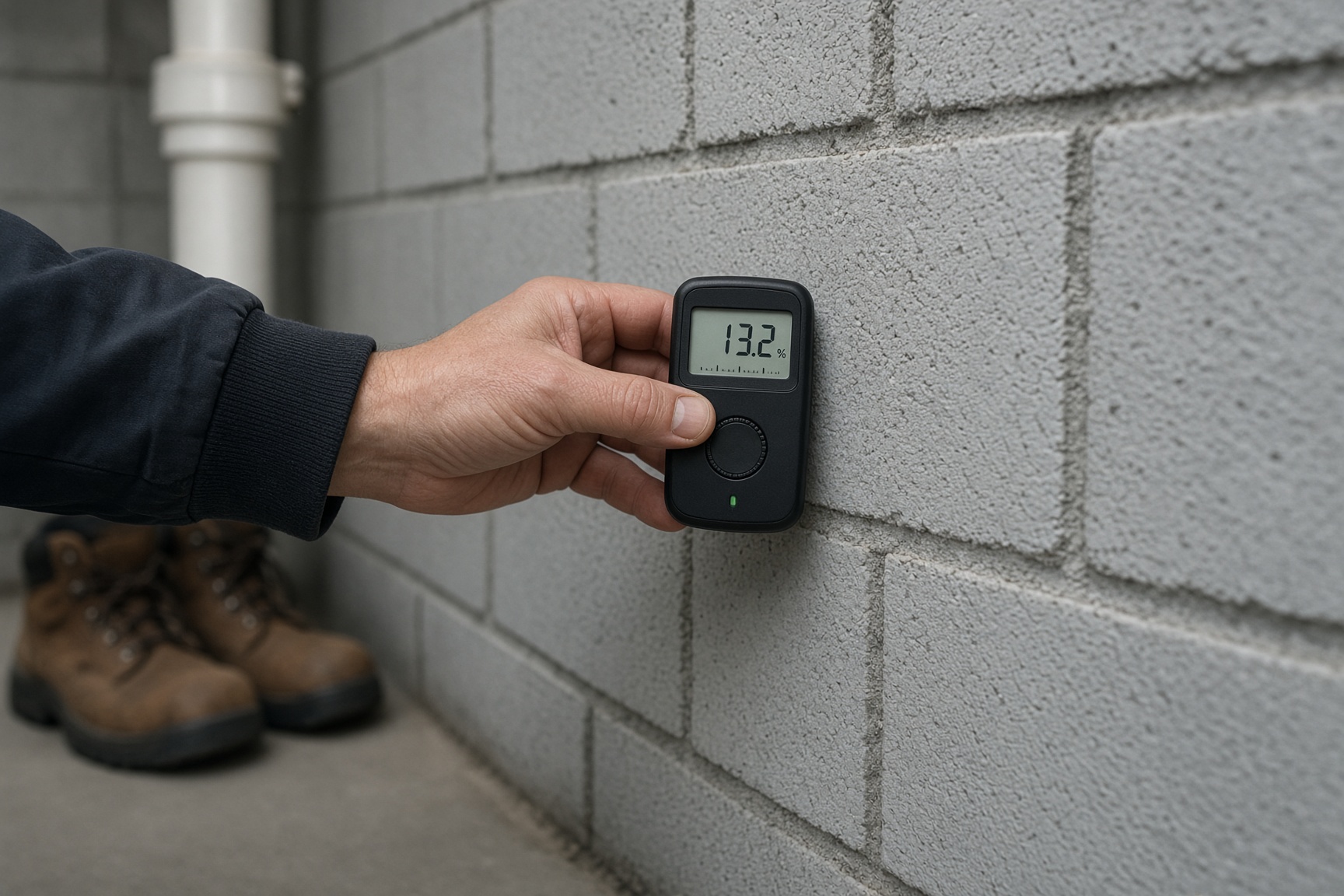
- Touch and tools. A pinless moisture meter on drywall more than a foot above the floor, or on a sill plate, shows whether the material is still wet. Stain without elevated moisture may be old.
- A gauge. Leave a hygrometer in the basement for a week. One afternoon reading means little. A string of days over 60% means the air itself is the problem.
Room by room in a typical York house
Basement. Look at the bottom two feet of finished walls, behind the water heater, around the sump, and where the washer hose can spray. Downtown rowhomes often hide it on the party-wall side where you cannot see the neighbor’s downspout. See basement mold.
Crawl space. Shine a light on joists, insulation paper, and the soil. Torn plastic and fallen fiberglass are the usual story. Crawl space mold is a problem even when nobody “lives” down there, because the stack effect pulls that air upstairs.
Baths and kitchen. Ceiling outside a shower, under a sink, and the back of a vanity cabinet. Bathroom ceilings are almost always a fan that does not vent outside or a fan nobody runs.
Attic. Sheathing stains after ice dams, bath fans dumping into insulation, and blocked soffits. Ice-dam attic mold shows up in February and gets ignored until August.
When a test is worth paying for
If you can see the mold and you can see the water, cleaning and drying beats sampling. Labs do not fix leaks. Sampling earns its fee when growth is suspected inside a wall, when someone medically vulnerable needs documentation, or when a Spring Garden or Downtown closing is stuck on “is this active?” Read testing versus inspection before you buy a $10 settling plate from a hardware store. Those plates grow whatever lands on them, including the air in your car on the way home.
What a false alarm looks like
Efflorescence — white crusty mineral deposits on brick or block — is salt left behind by water moving through masonry. It is not mold, but it is proof water has been moving. Dirt, soot from a candle, and cobwebs hold dust that looks biological until you wipe it and it does not return. If a spot wipes off, stays gone, and the meter reads dry, you are probably looking at dirt. If it ghosts back in a humid week, you are not.
Questions people also ask
+Does a musty smell always mean mold?
+Can I rely on a home mold test kit?
These pages are homeowner education from Radon Mitigation of York, written by Dave Kessler. They are not a medical diagnosis, a species identification, or an insurance determination. Color does not tell you which mold you have. If someone in the house is sick, talk to a physician. EPA's homeowner guidance treats roughly 10 square feet as the line where many people stop DIY cleanup and call a remediation crew — sooner if sewage, HVAC, or anyone immunocompromised is involved. We are a radon and basement crew. When we are already under a York house we will tell you what we see and what we would do in our own place. We do not pretend a radon fan is a mold remedy.